Impagliazzo’s Five Worlds
Russell Impagliazzo in 1995 published a paper called A personal view of average-case complexity in which he describes possible worlds which we could live in depending on some (still) unproven conjectures in complexity theory. Reviewing it almost 30 years later, understanding the relationships between certain assumptions and the outcomes of the truth or falsity of them is still fascinating.
I think especially considering the worlds from a cryptographer’s perspective is important. It’s useful to know the cascade of assumptions certain primitives rely on and the potential limits of cryptography in certain worlds.
Impagliazzo’s five worlds
Somewhat recently, I was reminded of Impagliazzo’s Five Worlds. The worlds are related to the unresolved problem of P vs NP, which revolves around the language classes P and NP. However, it also has distinguishes worlds via existence of a One-way function (OWF) and Trapdoor function (TDF).
In his paper, Impagliazzo illustrates the differences between “worst-case” and “average-case” hardness of problems through his 5 worlds:
- Algorithmica: (or something “morally equivalent”), where we can solve NP-complete problems efficiently
- Heuristica: but problems are still easy on average
- Pessiland: but OWFs do not exist
- Minicrypt: OWFs exist but TDFs do not exist
- Cryptomania: TDFs exist
These worlds follow from the following chain of implications:
All the propositions in that chain are conjectures at this point, but the implications are true. So, there are 5 possible settings for these propositions, each which corresponds to one of Imagliazzo’s worlds.
A note on hardness
Explain worst-case vs average-case hardness. TODO
There is also work trying to understand if actually could imply OWFs exist (or the barriers to trying to prove this):
- GG98 - On the possibility of basing Cryptography on the assumption that P != NP
- AGGM06 - On basing one-way functions on NP-hardness
Beyond the Five Worlds
The worlds laid out by Impagliazzo were useful to illuminate the differences between average-case and worst-case hardness. It also makes it clear how different types of cryptography rely on average-case and not worst-case assumptions.
However, there is a large body of both complexity and cryptography which prove a long list of implications from one conjecture to another. And, I personally think it would an interesting project (if infeasible) to enumerate and map all of these implications throughout the literature.
Instead of enumerating all of them though, I’ll just discuss a handful of them to illustrate the plethora of possible worlds we (for all we know) could be in.
FHE exists → does not follow from cryptomania circular security + TDF gets FHE?? Indistinguishability Obfuscation (weird because exists with P=NP) Weird quantum stuff
Breaking up Cryptomania
In his original paper, Impagliazzo actually suggested that Cryptomania includes the existence of Oblivious transfer and Homomorphic encryption. However, I’ve simplified the definition to just be the existence of a Trapdoor function.
Early work of GKM+00 lays out how these different primitives relate to each other. TODO continue explaining that this is pretty different than OWF, because OWF imply all sort of things
Obfustopia
Talk about iO together with OWFs
Microcrypt
Explain the recent ideas of cryptography even without one-way functions
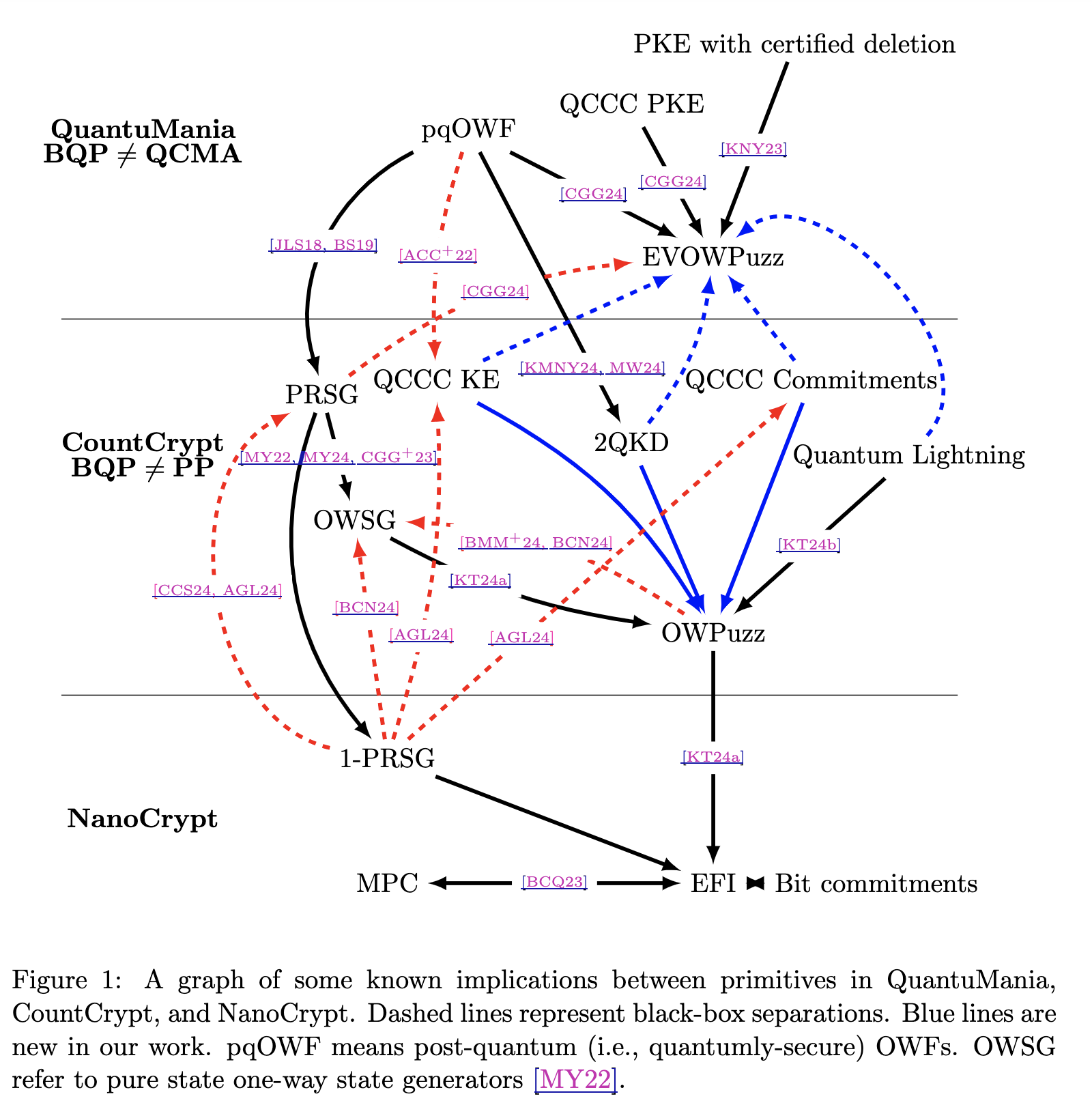
Explain the image below from GMMY24 - CountCrypt Quantum Cryptography between QCMA and PP.